
Shinemon Kiln: Arita Ware Shaped by Fire, Not by Brush

The pattern is written by the fire, not by the brush.
Pick up a piece from Shinemon Kiln and the first thing you notice is that the surface will not sit still. Tilt it, and gold specks drift across black like stars. Turn it again, and a red the colour of dawn deepens into purple. No two pieces are alike - not because of decoration, but because of what the fire did.
This is Arita ware at the edge of what a kiln can do. Here is what to look for, and why it is so hard to make.
First, what is Arita ware?

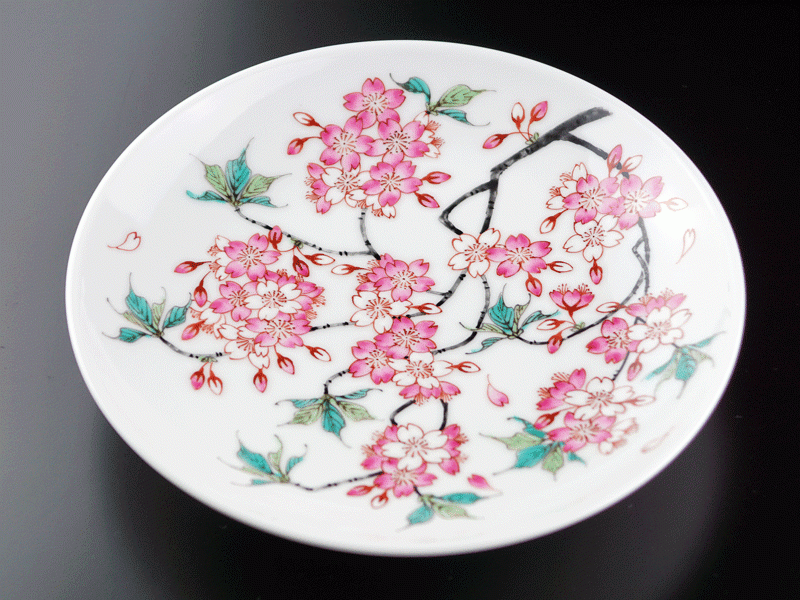
Turn a piece over and the Arita body shows: a clean, cool white, signed by the maker.
Arita ware is the first porcelain ever produced in Japan, made in the town of Arita in Saga Prefecture from the early seventeenth century. Carried to Europe by the Dutch East India Company, it was prized by royal courts as a luxury so valuable it was called "white gold," and it shaped the porcelain of Meissen and beyond.
What distinguishes Arita ware is the whiteness of the porcelain body. It is a clean, slightly cool white - and that white is the canvas on which everything below is worked.
Shinemon Kiln: a young kiln in a four-hundred-year town

The form is shaped by hand. The surface is left to the kiln.
Shinemon Kiln was founded in 1972 by the first Shinemon, Shinichiro Baba. By the standards of Arita, where some kilns trace their line back four centuries, that makes it a young house.
It is now led by the second generation, Kusuo Baba. Taught by his father, he spent years researching the glazes counted among the most difficult in ceramics, and in 2012 he received the Special Selection Award at Nitten - Japan's largest open art exhibition, and one of the most competitive honours a Japanese artist can receive.
The kiln's reputation rests on one thing above all: kiln transformation. The pattern is not painted on. It emerges from the reaction of the glaze to heat, and the maker can guide it but never fully command it.
The three glazes to know

Three glazes, three different answers from the same kiln.
1. Shinsha - cinnabar red

Shinsha is a copper-bearing glaze fired in a reduction atmosphere at extremely high temperature. Copper is unstable: a small shift in temperature, timing or the amount of oxygen in the kiln turns the red green, grey or nothing at all. When it succeeds, the result is a red with the depth of a ruby - sometimes flushing toward crimson, sometimes toward purple.
Shinemon Kiln works several variations. Akane-shinsha recalls a sky burning at daybreak; shiko-shinsha leans toward purple-red.


2. Yuteki Tenmoku - oil-spot black

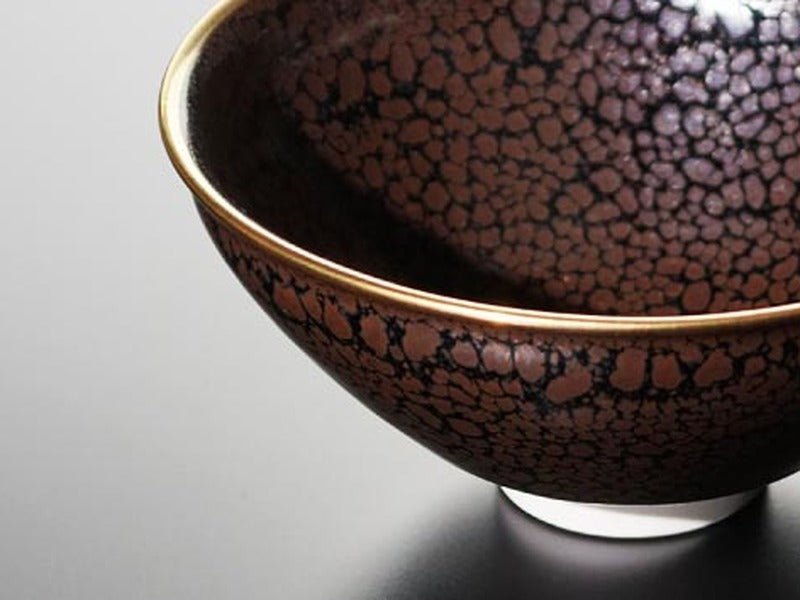
Tenmoku is a family of dark iron glazes that reached Japan from China with Zen Buddhism and became central to the tea ceremony. Yuteki tenmoku - "oil-spot tenmoku" - is the version in which iron rises through the melting glaze and cools into silvery droplets, scattered across the black like oil on water.
The spots cannot be placed by hand. Their size and distribution are decided in the kiln, which is why collectors read an oil-spot piece the way one reads a night sky.


3. Ginga - the galaxy

Ginga (galaxy) is Shinemon Kiln's signature, and an evolution of its oil-spot work: countless gold crystals glittering across a jet-black ground. Held at different angles, under different light, the same cup changes colour and depth.
A more lavish version, Seiten, adds pure gold or pure platinum. Ginga appears on mugs, yunomi teacups, coffee cups and whisky glasses, so it is one of the easier ways to bring a piece of this kiln into daily use.


How to choose a piece

Same kiln, two temperaments: oil-spot tenmoku and shinsha red.
- Decide where the light will fall. Ginga and oil-spot tenmoku are at their best where light moves - a window, a lamp, a table you sit at in the evening. In a dark cabinet they lose half of what they are.
- Expect variation, and want it. Because the pattern is made by fire, the piece you receive will not match the photograph exactly. That is the point of kiln transformation, not a flaw.
- Start with a yunomi or a mug. These are the pieces made in the widest range of glazes, and they are used every day rather than displayed once a year.
- For a gift, consider a pair. Paired teacups and rice bowls - meoto, "husband and wife" sets - are a long-standing Japanese gift for weddings and anniversaries.
A note on care

Metallic glazes and gilt rims are the reason these pieces are washed by hand.
These are porcelain pieces with metallic and reduction-fired glazes. Wash by hand in warm water with a soft sponge, and avoid abrasive cleaners, which dull the surface. Pieces decorated with gold or platinum must never go in a microwave.
See the work
Shinemon Kiln is the largest single collection on JTOPIA, with over a hundred pieces ranging from everyday teacups to matcha bowls held as art.