
Article: Arita Ware: A Guide to the Styles of Japan's First Porcelain, and How to Choose
Arita Ware: A Guide to the Styles of Japan's First Porcelain, and How to Choose

Arita ware is Japan’s first porcelain. In 1616 a vein of porcelain stone was found at Izumiyama, in the town of Arita in Saga Prefecture, and porcelain has been made there ever since. Four centuries is a long time, and the town has produced a great many looks along the way: cobalt blue on white, brilliant enamels, gold, celadon green, plain white, and black glazes scattered with silver.
That variety is the first thing that confuses people new to Arita. This guide is a map. It names the main styles, shows how to tell them apart, and ends with a simple way to choose a piece by how you will use it. For the town, the stone and how the porcelain is made, see About Arita Porcelain.
Arita, Imari, Ko-Imari: one porcelain, three names
Before the styles, the names. Arita porcelain left Japan through the nearby port of Imari, so the world came to call it Imari ware. Pieces made before the Meiji era are known today as Ko-Imari, “old Imari.” While Japan was closed to the outside world, the Dutch East India Company carried it to Europe, where it was called white gold and filled the palaces of kings and nobles.
So if you see a piece described as Arita, Imari or Ko-Imari, it comes from the same place. The difference is mainly one of period, and, as we will see, Ko-Imari is also the name of a style.
Sometsuke: blue and white

A sometsuke teacup with the frolicking animals of the Choju-giga scrolls, Sojiro Kiln.
Sometsuke is where Arita begins. Cobalt pigment, called gosu, is painted onto the porcelain, covered with a clear glaze and fired. Because the blue lies under the glaze, it cannot wear off. Classic sometsuke has no other color: white ground, blue painting, nothing else.
It is the most basic of the Arita styles and, for many people, still the most beautiful. Our history of sometsuke traces it from Tang China to Arita; the Sometsuke collection gathers the pieces we carry, from everyday teacups to vases.

Somenishiki: blue, color and gold

Detail of a phoenix plate in somenishiki with platinum, Fujii Kinsai.
Somenishiki begins as sometsuke, with blue under the glaze, and then adds enamels on top: red, green, yellow, gold, platinum. The piece goes back into the kiln at a lower temperature to fix them. The result is richer and more festive, and you can often feel the enamels standing slightly proud of the surface.
Fujii Kinsai is known for modern somenishiki and for his own gold and platinum techniques. On his large camellia plate, the flowers in crimson, pale wisteria, indigo and jade are set against dazzling gold; every decorative plate we carry is painted entirely by hand, so each is one of a kind. On his sake cup, peonies outlined in indigo bloom among scales of platinum, and the surface is worked so that it catches the light as you turn it.


Iro-e and the Kakiemon style

A large vase with a mountain landscape in iro-e, by Obata Yuji of Jin Kiln.
Iro-e simply means “color painting”: enamels painted over the glaze. Within it, the best-known style is Kakiemon. It is painted on a milky white body in fine black outlines and bright color, and it is defined as much by the empty white as by what is painted. Kakiemon was exported to Europe in quantity and copied there, Meissen above all.
Jin Kiln, led by Obata Yuji, is a leading kiln of the Kakiemon style, and its work has been presented to the Emperor and Empress (now the Emperor Emeritus and Empress Emerita). Its cherry blossoms are painted entirely by hand with an extremely fine brush, and the white is left open on purpose: in Japanese ceramics, the empty space matters as much as the painting. Kakiemon is often painted in a clear red; on the cup and saucer, the blossoms are a softer pink. Read more in our profile of Jin Kiln.


Ko-Imari and Nabeshima

A large plate in the kinrande style with pine, bamboo, plum and sea bream, Kajiken Kiln.
Arita is usually divided into three historic styles: Kakiemon, Nabeshima and Ko-Imari. Nabeshima was the work of the domain kiln. It was not made to be sold: it was the tableware of the lord of Saga, and the gift he sent to other lords and to the shogun. Iro-Nabeshima is drawn first in indigo, then painted over in red, yellow and green.
Ko-Imari, as a style, covers the rest, and its best-known technique is kinrande: gold applied over the finished painting and fired on. It is the dense, gilded look most people picture when they think of antique Imari. Fukusen Kiln’s Shikohai glass carries that look on a porcelain stem, painted entirely by hand in a manner that recalls the Imari of old; even for a skilled artisan, one piece can take half a year. Our guide to what an Arita plate is worth explains all three styles in more detail.

Celadon: color from the glaze alone

Kikkou Seiji matcha bowl by the first Shinemon.
Seiji, celadon, has no painting at all. The color, a blue-green that can run from pale sky to deep jade, comes from the glaze itself. Celadon came from China, where it was prized from the Song dynasty as a color of nobility and refinement, and Nabeshima made its own celadon alongside its painted wares.
The first Shinemon’s vase takes the Nabeshima celadon of Imari’s golden age into the present, with a delicate crackle running through its deep blue-green. The set of five sencha cups is glazed in kinuta seiji, the clear, watery blue regarded as the finest of all celadons; the cups take the tenmoku shape, open at the mouth and narrowing to a small foot.


Hakuji: the white of the porcelain itself

Peonies carved by hand into a white porcelain rice bowl, Yamaguchi Mikihiko of Yamamiki Kiln.
Hakuji is white porcelain with no color at all, and it is the most demanding test of the material. Arita’s stone fires white and almost translucent, and hakuji simply lets that show. Instead of painting, decoration comes from the form, or from carving into the body, where the glaze pools and the light makes the pattern.
Yamaguchi Mikihiko of Yamamiki Kiln carves peonies by hand into white and bluish-white porcelain. Read our profile of Yamamiki Kiln to see the work.
Glazes shaped by fire: tenmoku, yuteki and yohen

Horaisan vase in tortoiseshell tenmoku, Shinemon Kiln.
Not every Arita style is painted. Some patterns are made by the kiln. Tenmoku is the Japanese name for a family of dark, iron-rich glazes, from deep black to the amber of tortoiseshell tenmoku. In yuteki, “oil-spot,” tenmoku, silvery or golden-brown crystals float in the black like drops of oil on water; warlords such as Oda Nobunaga and Toyotomi Hideyoshi treasured it. More broadly, these effects are called kiln transformation, yohen: the glaze changes in the heat, so the maker can guide the result but never fully control it, and no two pieces are alike.
Shinemon Kiln is known above all for this work, and Shinemon is regarded as one of Japan’s leading artists of kiln transformation. The Ryurin teacup, light and narrowing gently to its foot, shows oil spots on fine Arita porcelain, and the set of five round plates gathers the kiln’s popular crystal glazes in a shape deep enough for everyday use. See our introduction to yuteki tenmoku, the story of Shinemon Kiln and the Yuteki collection.


Hand-painted or printed?
Whatever the style, one question separates most Arita pieces in price: was it painted by hand, or printed by transfer? A painted line varies; a printed one does not. Hand-painted enamel often stands slightly proud of the surface, while a transfer is flat. We explain how to tell in what an Arita plate is worth.
Choosing by how you will use it

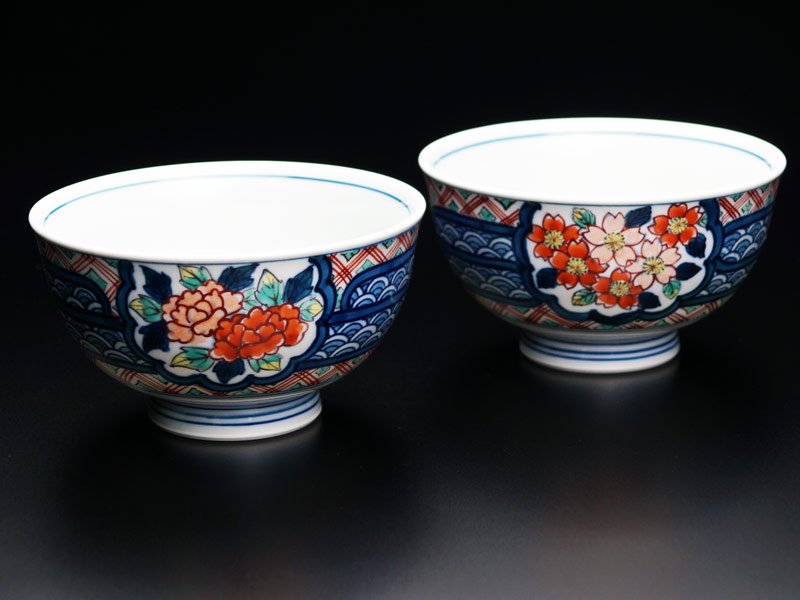
A rice bowl and teacup set with cherry blossoms in iro-e, Jin Kiln.
Once you know the styles, choosing becomes simpler. Start with what the piece is for, then pick the style you love.
- Tea every day: a yunomi, the handleless Japanese teacup. See Cups and our guide to Japanese teacups.
- Coffee: a mug or cup and saucer, also in Cups. Coffee cup or tea cup? explains the difference.
- Rice and everyday meals: a rice bowl from Bowls.
- Sake: a single cup from Sake Cups, or a flask and cups from Sake Sets.
- Whisky: a porcelain rocks cup from Whisky Glasses.
- Matcha: a tea bowl from Matcha Bowls.
- To display: a large decorative plate or a vase, where somenishiki, Kakiemon and celadon show at their best.
A simple rule of thumb: for daily use, sometsuke and the kiln-transformed glazes are easy to live with; for a gift that makes an impression, somenishiki and gold; for quiet elegance, Kakiemon, celadon or white.
See Arita for yourself
If you ever visit, walk the back streets of the town, past low walls built from the fire bricks of old kilns and shards of porcelain. We wrote about it in the Tonbai walls of Arita. Until then, you can explore the work of Arita’s kilns in our collection.