
What an Arita Plate Is Worth: Hand-Painting, and the Three Styles

Run a finger over a hand-painted plate and you can feel where the brush went.
Arita plates run from a few pounds to the price of a car, and the difference is not always obvious from a photograph. There is one question that separates most of them, and two more that tell you what you are looking at.
Hand-painted, or transferred?

This is the first thing to establish, and it accounts for most of the price gap.
Transfer means the design is printed - the pattern is applied to the porcelain as a print. It is quick, it is repeatable, and it needs no particular skill.
Hand-painting is the other thing entirely. The elaborate work - kenjō kinrande, kenjō ko-imari - takes three months to a year for a single piece.
You can tell them apart without any expertise:
- Look for unevenness. A painted line varies. A printed one does not.
- Then touch it. Hand-painted enamel stands slightly proud of the surface - you can feel the relief under a fingertip. A transfer is flat.


The three styles of Arita
Once you know a plate is hand-painted, the next question is which tradition it belongs to. Arita is usually divided into three.
1. Kakiemon

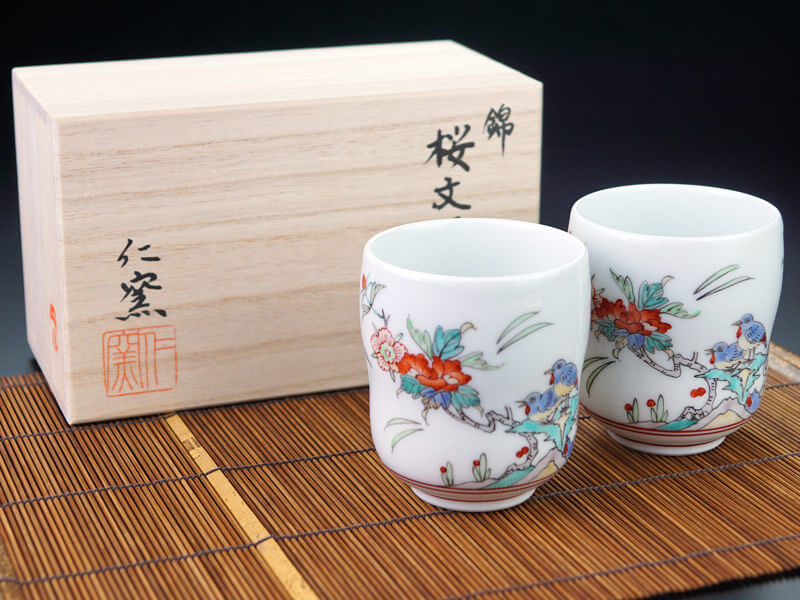
Kakiemon: fine black outlines, bright color, and a great deal of empty white.
Kakiemon is painted on nigoshide - a milky, slightly warm white body - and it is defined as much by what is left blank as by what is painted. Plenty of white is kept. The outlines are extremely fine and black. The colors are red, green, yellow and blue; later work adds purple and gold.
The subjects are birds, flowers and seasons, arranged asymmetrically rather than centerd. Rims are often finished with kuchisabi, an iron-brown glaze. Recurring motifs include birds on flowering plum, deer among maples, a tiger in bamboo, quail in millet.
Kakiemon was exported to Europe in quantity, and it was copied there - Meissen produced a great many imitations of it.
2. Nabeshima

Iro-Nabeshima: indigo laid down first, then red, yellow and green over the glaze.
Nabeshima is the domain kiln style, and it shows in the care taken with parts nobody was supposed to notice: a bluish body, a combed foot ring, and patterns on the underside.
It divides three ways. Iro-Nabeshima is drawn first in indigo, fired, then painted over in red, yellow and green. Ai-Nabeshima is indigo alone, worked very finely. Nabeshima celadon is the natural blue-green glaze with no painting at all.
Iro-Nabeshima was not made to be sold. It was the tableware of the lord of Saga, and the gift sent to other daimyo and to the shogunate - which is why the standard is what it is.
3. Ko-Imari

Ko-Imari means “old Imari” - Arita porcelain of the Edo period, shipped out through the port of Imari. As a style label it covers everything that is neither Kakiemon nor Nabeshima.
Its best-known technique is kinrande: once the painting is complete, gold is applied over the surface and fired on. The result is the dense, gilded look most people picture when they think of antique Imari, and it remains the format most often chosen as a wedding or housewarming gift.
Choosing a plate

- Decide first whether it is to be used or shown. A decorative plate is made to be seen upright on a stand; the painting is composed for that.
- Check the rim and the back. The two places a maker cannot hide are the lip and the foot. Careful work there usually means careful work everywhere.
- Gold has a cost. Kinrande and gold-ground pieces are heavier in labor and material, and priced accordingly.
- Expect variation. Hand-painted work differs piece to piece. That is the thing you are paying for.


See the work
Twenty-one plates on JTOPIA, from every kiln we carry.