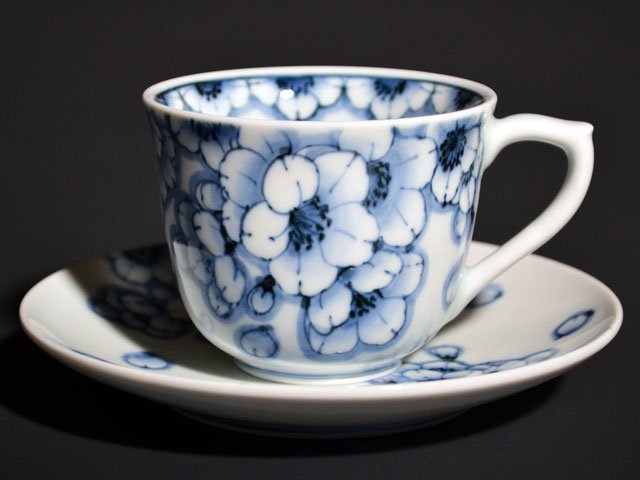

Article: Sometsuke: Japanese Blue-and-White, and What Somenishiki Means
Sometsuke: Japanese Blue-and-White, and What Somenishiki Means

Two words turn up again and again on Japanese porcelain: sometsuke and somenishiki. They are not interchangeable, and once you know where to look, the difference is easy to see.
Both begin in the same place — cobalt blue, painted onto the porcelain before the glaze goes on. What happens after that is where they part.
What sometsuke is
Sometsuke (染付) is cobalt painted directly onto the porcelain body, covered with a clear glaze, and fired. Because the pigment sits under the glaze, it is sealed in. It cannot scratch off, wear away at the rim, or fade with washing.

The blue is beneath the glaze. What you touch is glass; the painting is underneath it.
The pigment has its own name in Japanese: gosu. In the hand it is a dull gray powder, and nothing about it looks like the blue it will become. The color only arrives in the kiln.
In classic sometsuke that blue is the only color there is. White ground, blue painting, nothing else.


From Tang China to Arita
Blue-and-white did not begin in Japan.
The oldest known pieces are Chinese, from the Tang dynasty, around the 9th century — made at the Gongxian kilns in Henan. We can date them with unusual confidence because of a shipwreck. An Arab dhow went down off Belitung Island, in what is now Indonesia, in or shortly after 826. Among the tens of thousands of Chinese ceramics in its hold were three blue-and-white dishes. No other complete Tang blue-and-white pieces are known to survive.

A dense all-over blue. The look traveled from China long before Japan could make it.
The technique reached Japan with the envoys sent to Tang China, who carried ceramics home with them — the middle of the Heian period, by Japanese reckoning. Seeing it and making it, however, are different problems, and the second one took Japan several more centuries.
Full production began in the 17th century in Arita, in Saga Prefecture. What Arita shipped out, under the name of the port it left from — Imari — spread across the whole country. Kutani in Ishikawa grew from that root. It is barely an exaggeration to say that most Japanese ceramics carry some Imari in them.


What Japan changed
Japan did not simply copy the method. It altered one step — and that step changed the work.
In China, at Jingdezhen, the blue went straight onto the raw, unfired body. A single firing did everything at once.
In Arita the body is bisque-fired first, at around 900°C, and only then painted. The brush meets a surface that has already been through the kiln.

Fine line and filled shading, done on a surface that absorbs the pigment on contact.
That surface is porous. It drinks the pigment the moment the brush touches it. There is no moving a line afterward, no wiping back, no second thought. Whatever the brush does is what the piece will carry out of the kiln.
The painting is done in two stages with two brushes. A fine brush draws the outline — sen-gaki. Then a thick brush fills and shades inside those lines — dami. The dami brush is what gives hand-painted sometsuke its depth: the blue is not flat but light in places and deep in others, and that gradation is a person’s hand rather than a printed sheet.
If you want to tell a painted piece from a transfer-printed one, this is where to look. We went into that in detail in what an Arita plate is worth.


Sometsuke, or somenishiki?
Now the second word.
Sometsuke is blue under the glaze, and nothing more.
Somenishiki (染錦) begins the same way — cobalt under the glaze — and then adds enamels on top of the fired glaze: red, green, yellow, gold, platinum. The piece returns to the kiln at a lower temperature to set them.

Somenishiki: the blue sits under the glaze, the reds and greens on top of it.
So somenishiki is sometsuke with color added. You can usually see which is which: the blue looks sunk into the surface, while the enamels sit slightly proud of it and catch the light differently. On many somenishiki plates you can feel where the red is with a fingertip.
Which is better is not a real question. Sometsuke is quieter and sits comfortably with anything else on a table. Somenishiki is made to be looked at — which is why so much of it takes the form of decorative plates and vases rather than everyday bowls.


See the work
Thirty-six pieces in blue and white on JTOPIA, from four kilns.