
Article: Japanese Christmas Gifts: Handcrafted Pieces from Japan's Master Kilns
Japanese Christmas Gifts: Handcrafted Pieces from Japan's Master Kilns

A gift from Japan’s master kilns and workshops is something to be used, not kept on a shelf: a cup for the morning coffee, a set of sake cups for the evening, a pair of glasses to raise together. Most of the pieces below are painted, carved or glazed by hand, so each one carries the mark of the person who made it.
This guide gathers our Christmas picks by the person you are giving to — coffee and tea lovers, sake and whisky drinkers, couples, and the one who already has everything — with a few tips on choosing at the end.
For coffee and tea lovers

Cherry blossoms and birds, painted by hand by Yuji Obata of Jin Kiln.
A cup that is used every morning is a gift that is remembered every morning. These cups pair the porcelain of Arita, a town in Kyushu that has made porcelain for some 400 years, with the hand of a single master.
Yuji Obata of Jin Kiln, who works in the Kakiemon style, paints his cherry blossoms and birds by hand with an ultra-fine brush, so the composition varies slightly from mug to mug. Shinemon, the glaze master of Shinemon Kiln and a winner of the Special Selection Award at the Nitten, Japan’s largest art exhibition, made Hananohikari as a JTOPIA limited edition: kiln-transformed cinnabar red, with genuine gold leaf. In Japan, red is an auspicious color, believed to ward off misfortune. (Wondering whether to give a coffee cup or a teacup? See our guide to the difference.)


For sake and whisky lovers

Eight guinomi, eight Shinemon glazes.
A guinomi is a sake cup a little larger than the tiny ochoko, made to be held and turned in the hand. At Shinemon Kiln, the pleasure is in the glaze: yohen, or “kiln change,” means the color is transformed by flame and heat inside the kiln, so the potter can never fully decide the result. No two pieces come out alike.
The set of eight guinomi gathers eight different Shinemon glazes in one box, like a jewel case — a gift that invites the recipient to pick a different cup for every evening. The five whisky glasses bring together five yohen colors recommended by Shinemon himself, each with a textured side that sits securely in the hand.


Gifts for two: pairs for couples

The moon rabbit on Gagyu Kiln’s teacups.
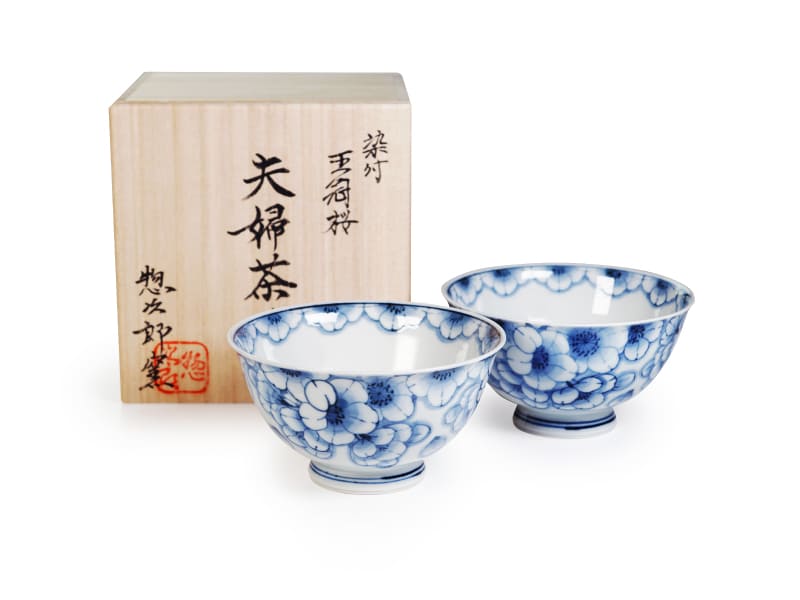
In Japan, a pair of matching cups or bowls made for a couple is called meoto, and it is a classic gift for a wedding or an anniversary. The idea travels well: two pieces that belong together, for two people who do.
Gagyu Kiln’s moon rabbit teacups draw on an old belief, shared across Asia, that a rabbit lives on the moon; in Japan the rabbit is a lucky motif, linked with harmony and with moving forward. The Kihaku Glass wine glasses by Uchiki, a Yamanaka lacquerware maker founded some 130 years ago, carry gold and silver leaf scattered by hand by skilled artisans — no two glasses share the same pattern.

![Yamanaka Lacquerware - [Kihaku Glass] Pair of Wine Glasses "Revel"](https://cdn.shopify.com/s/files/1/0797/4227/1763/files/5526_01_1200.jpg?v=1789349245)
For someone who has everything

Kissho Akafuji, an auspicious red Fuji in Kyoto cloisonné.
For the person who is hardest to buy for, a work of art may be the answer. Kyoto shippo is Japanese cloisonné: vitreous enamel fired onto metal, a craft with a thousand years of history. Yoshihiro Akagawa, a master with more than fifty years in the craft, carries out every stage himself, from making the base to the final polish — work that is usually divided among specialists.
His framed Kissho Akafuji, an auspicious red Mount Fuji, makes a striking piece for a home or office; his pure silver brooches are a gift to wear. (Read more in our guide to Japanese cloisonné.)


How to choose

Leaf laid by hand: no two glasses share the same pattern.
Start with what they drink. Coffee, green tea, sake, whisky or wine — a piece made for a daily habit is the one that gets used.
One, two, or a set. A single cup is personal; a pair suits a couple; a set of guinomi or glasses is made for sharing with friends.
Expect each piece to be its own. With hand painting, hand-laid leaf and kiln-changed glazes, small differences between pieces are part of the craft, not a flaw.
Check the details. See each product page for size and care before you order. Every order ships from Japan, so we suggest ordering early for Christmas.
A few more pieces from our Christmas picks:


![Yamanaka Lacquerware - [Kihaku Glass] Japanese Sake Set, Full Gold Leaf](https://cdn.shopify.com/s/files/1/0797/4227/1763/files/5545_01_1200.jpg?v=1789453834)