
Japanese New Year Tableware: Auspicious Designs to Start the Year

In Japan, the New Year — Shogatsu — is the most important holiday of the year. Homes are cleaned, families gather, and the first days of January are celebrated with special food served on the best tableware in the house. The designs chosen for the season are rarely only decorative: each carries a wish for the year ahead, whether long life, prosperity or a happy new beginning.
This guide introduces the auspicious motifs you will often see on Japanese New Year tableware — the sea bream, red and white, plum blossoms and Mount Fuji — together with pieces from Japan’s master kilns that carry them.
Shogatsu: the Japanese New Year and its tableware

Crane, pine, bamboo and plum on a decorative plate from Fujii Kinsai Kiln.
The centerpiece of the New Year table is osechi ryori, an assortment of dishes prepared in advance and packed into tiered lacquer boxes. Many of the dishes carry a wish in their name, shape or color. The sea bream, tai, is a favorite at celebrations because its name echoes medetai — “joyful” or “auspicious” — and its red skin is a festive color in itself.
The pair of sea bream plates from Kajiken Kiln is finished in gold and platinum, a size suited to side dishes or sweets, and comes in a paulownia box. On Fujii Kinsai Kiln’s decorative plate, two cranes stand among pine, bamboo and plum — shochikubai, the “three friends of winter”. The evergreen pine stands for long life, the bamboo for strength that bends under snow without breaking, and the plum, blooming in winter, for vitality; pine and bamboo also form the kadomatsu placed at the entrance of homes for the New Year. The crane, said to live a thousand years, is a symbol of longevity, and here its feathers shine in gold and platinum. Like every decorative plate we offer, it is painted entirely by hand, without transfers.


Red and white: the colors of celebration

Kohaku Housai from Shinemon Kiln: a shinsha red cup and a white tenmoku cup.
Red and white — kohaku — are Japan’s colors of celebration. They appear on the cords that tie gift envelopes, on the red-and-white fish cake in the osechi box, and even in the name of Kohaku Uta Gassen, the song contest between a red team and a white team that many families watch on New Year’s Eve. A pair of pieces in red and white makes a natural gift for the season.
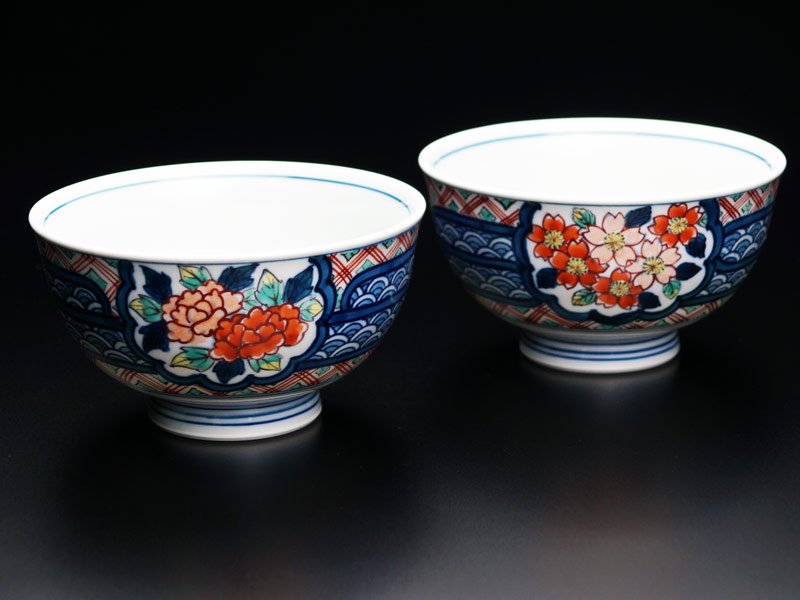
Shinemon Kiln’s Kohaku Housai pairs the Hananohikari cup, glazed in a deep, burning shinsha red, with the pure white Shiro Tenmoku cup, on which crystals rise from the glaze like drops of water or jewels. The rims are finished in gold, and the pair is suited to celebrations such as weddings and long-life birthdays. Gagyu Kiln’s meoto rice bowls — a “husband and wife” pair — bring red and white together in a gentler way, with red plum on one bowl and white plum on the other.


Plum blossoms: the first flower of the year

Red plum and white plum on Gagyu Kiln’s yunomi teacups.
Long before the cherry blossoms, the plum opens in the cold of late winter, sometimes while snow still lies on its branches. In Japan it is called the first of all flowers to announce spring, and because the New Year was once celebrated at the start of spring, New Year greetings still speak of a “new spring”. Red and white plum together are a classic motif for celebrations.
Gagyu Kiln works in Utsutsugawa ware, known for its thin walls and the flowing hakeme brushwork laid over brown clay, and designated an intangible cultural property of Nagasaki Prefecture. On these pieces the plum branches are not shown in full bloom: buds and half-opened flowers suggest a tree coming to life after the hard winter, and each piece of a pair is painted a little differently. The mutsuzoroi set brings together a pair of rice bowls and a pair of yunomi teacups. (Read more about Gagyu Kiln.)


Mount Fuji and the first dream of the year

Mount Fuji and cherry blossoms in gold and platinum, from Fujii Kinsai Kiln.
The first dream of the New Year, hatsuyume, is said to foretell the year ahead. The luckiest dream of all is summed up in an old saying: ichi-Fuji, ni-taka, san-nasubi — “first Mount Fuji, second a hawk, third an eggplant”. One popular explanation is wordplay: Fuji is the highest mountain in Japan, taka also means “high”, and nasu sounds like a word for achieving one’s goals. Mount Fuji has long been a sacred mountain and a favorite auspicious subject in Japanese art.
Myojo Fuji is a framed ceramic artwork made for JTOPIA by Shinemon Kiln, with Mount Fuji drawn in glaze against jet-black tenmoku using glazes of the artist’s own, such as shinsha. Shinemon rarely depicted Mount Fuji, apart from one period when he made Fuji works with remarkable intensity. Fujii Kinsai Kiln’s cups show Fuji and cherry blossoms in platinum and gold against a background of glossy and matte scales, and can be used for wine or for sake.


More auspicious pieces
Red dragon clouds trailing over a jet-black tenmoku ground — a sign of rising fortune; plum blossoms in pale purple and indigo with branches in gold, the flower that marks the beginning of things; and a coffee cup with red plum over flowing hakeme, for the first quiet mornings of the year.